
An introduction to Mashing
Although brewing beer from kits, and from malt extract, can produce some excellent results, many brewers would like to progress to another level by going all-grain. This final step is not as difficult as many would have you believe. In fact it can be made quite simple.
This booklet has been produced for brewers to assist them in brewing world class beers at home using the most elementary of mashing techniques coupled with very basic equipment.
We are not implying that you should not try more sophisticated equipment and techniques, just that you can be successful with these basic methods. Perhaps it will even encourage you to advance to that higher plane of sophistication.
Mashing Procedure
The Mash
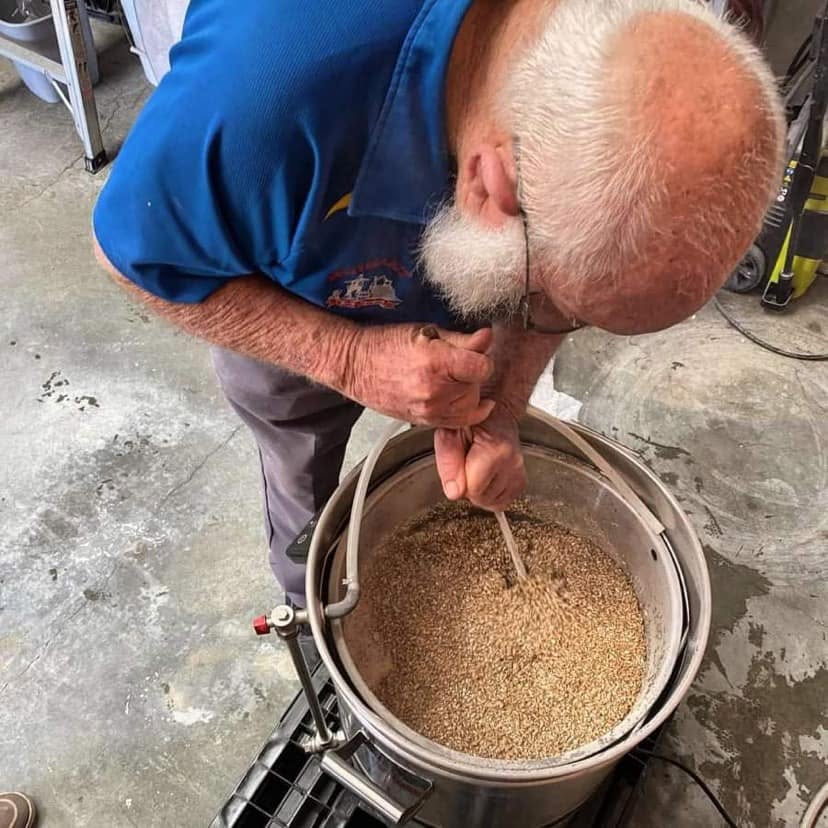
We use a double bucket system that can be either copied, or modified to suit equipment that you have. The basic method can be related to pretty well any system you will find in the myriad of brewing books available.
First is to make sure all equipment is clean. Heat the mash water to about 80c and add to the mash tun. We use about 3 litres per kilo of grain. Adjust the temperature to “strike water” temperature (usually about 72C – see calculations on page 4) Next stir in all of the grain, stirring to make sure it is all evenly wetted.
The temperature will now be at 65-66c. You need to now try to maintain this temperature for 90-120 minutes. This can be achieved by the addition of small quantities of boiling water every 15 minutes and stirring; or by turning on the heater element for a couple of minutes if you have a similar system to ours.
A temperature drop of a few degrees over the period of the mash is not too much of a problem, but initial “strike” temperature is important. (See page 4 under “Mash Temperatures”)
The Sparge
While the mash is under way we can heat the sparge water to about 80C. (Calculation of quantity of sparge water is on page 7 under “Batch Sparging”)
Sparging is best carried out at between 76-78C, at which temperature the enzymes are destroyed (“mash-out”), the sweet wort is thinned down to flow better and the sugars are more soluble, but the temperature is not high enough that excess tannins are extracted from the husks. To do this effectively the mash must be heated by the heater element, or by the addition of hot water. (Some of the sparge water works fine)
Sweet wort can be now slowly run off into a jug and returned gently to the top of the mash until the wort begins to clear. This way the grain bed is used to effectively filter out the trub. The wort can now be run into the boiler and the actual sparge can proceed.
There are two common methods:
1. Fly sparging where the heated sparge water is gently sprayed onto the top of the grain bed as the wort is being run into the boiler. (Trying to keep a thin layer of liquid on top of the grain bed until the sparge water is all used.)
2. Batch sparging, which is our preferred method. (See page 6 to 8 for an article by Steve Nicholls)
The Boil
Bring the sweet wort to the boil. Be ready to stir as it reaches boiling point so as not to boil over. Allow to boil for 30 minutes and then add the bittering hops. At this addition it is imperative that you stir as it will want to boil over. Once it has settled down to a good even rolling boil, it can be left to boil for a further 60 minutes. Whirlfloc kettle finings can be added 15 minutes before the end of the boil, and the flavour hops at 5 minutes. Note that if you are using a wort chiller, you need to put this in for about 5 minutes.
Cooling
The bitter wort must now be cooled to about 30C. The quicker you do this the better. You can stand the boiler in a trough of cold water, or you can use a cooling coil. The wort can now be transferred to the fermenter, stirring and splashing it to dissolve oxygen, and the yeast can be pitched.
Fermentation
Your beer can now be fermented as normal.